

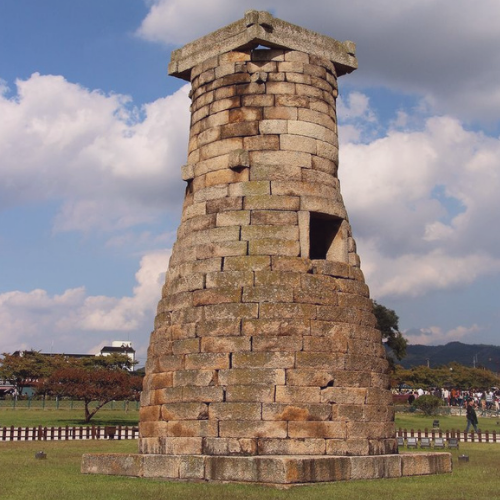
The Cheomseongdae (첨성대) observatory is the oldest surviving astronomical observatory in Asia and one of Korea’s most treasured landmarks, dating back more than 1,300 years. This stone tower gazes at the sky in Gyeongju.
It was built during the reign of Queen Seondeok of the Silla Kingdom, and its name translates to “star-gazing tower.” There were no telescopes in those times, but people still studied the stars and planets through these tall structures.
The Cheomseongdae looks simple from the outside, but it is actually full of hidden meanings. The 9-meter height and 362 granite stones represent the days in a lunar year, while the 27 layers of stones symbolize Queen Seondeok, the 27th ruler of Silla.
The middle has a small square opening for setting up instruments to measure sunlight and starlight. The tower’s square base represents the earth, and its round body represents the heaven, reflecting the Korean belief in the balance between nature and the universe.
During the Silla era, astronomers used simple observation tools such as sighting poles, ropes, and shadow sticks. They climbed to the top to observe the movement of the sun and moon and to see when stars appeared or disappeared at certain times of the year. This information helped them mark seasonal changes, predict rainfall, plan the agricultural calendar, predict eclipses, determine the best times for festivals, and even predict royal copulation.
Silla scientists laid a strong foundation for Korean astronomy, and their methods were passed down through generations, influencing how later Korean kingdoms developed more advanced observatories and time-measuring devices as the centuries rolled by. Even though Cheomseongdae lacked telescopes or lenses, its systematic approach to observing the sky inspired later inventions. The focus on precise measurements, record-keeping, and calendar-making helped Korea’s scientific progress.
Centuries later, during the Joseon Dynasty, Korea built even more advanced observatories and tools, such as armillary spheres, sundials, and water clocks, that were based on the same curiosity and careful observation that began at Cheomseongdae. In this way, the tower’s legacy lives on in modern astronomy and meteorology, which still rely on accurate sky observation to understand time and weather.
Today, Cheomseongdae is a UNESCO World Heritage Site and one of Gyeongju’s top attractions. It sits in a large grassy park surrounded by royal tombs and wildflowers. During the day, you can stroll around and take pictures of the tower against a bright blue sky. At night, it’s beautifully lit, glowing under the stars. Gyeongju also features the Anapji Pond, Bulguksa Temple, and the Gyeongju National Museum, all close to the stone tower. They complete the story of the Silla Kingdom and its outstanding achievements.
Cheomseongdae shows how ancient people used creativity, mathematics, and observation to understand the world long before telescopes existed. When you stand before Cheomseongdae, look up at the stars with curiosity and imagine ancient astronomers doing the same as they opened the path that modern science still follows today.
Like Loading...

Author
Damilola Jimmy
The ink drips smartly over here. Let me take you through the world of my imagination while riding on the letters😎 It's all fun in this corner.

Previous Post



Leave a comment